Rapidly increasing production, strong growth trajectory, healthy dividend, focused management. Is 2019 the year where markets begin to fully appreciate the business model of Diversified Gas & Oil?

Final Results released by Diversified Gas & Oil show that it delivered a substantial increase in production, reserves and earnings for the year, as well as a strong dividend to top it all off.
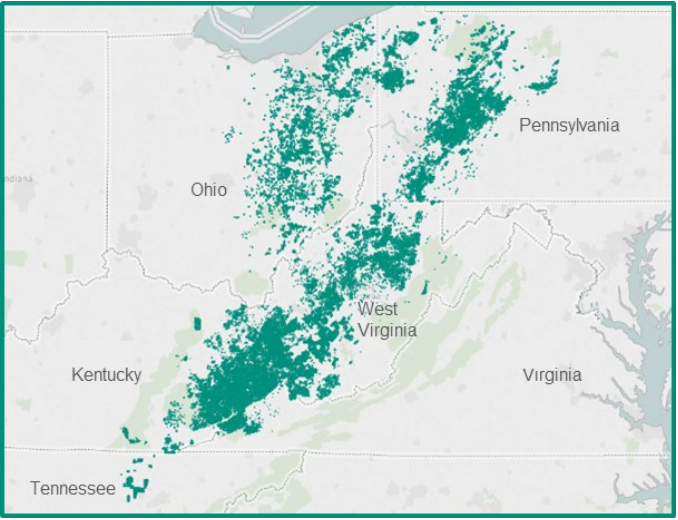
The company owns and operates wells in the prolific Appalachian Basin, the largest and oldest hydrocarbon producing field in the US. It is also the largest conventional producer on AIM, where it listed in February 2017.
2018 saw DGOC increase its proven, developed and producing (PDP) reserves to 474 MMboe, a 8-fold increase, and saw it bring daily production to 70,000 Boe in Q4 ‘18, a circa. 7-fold increase from Q4’17.
In a transformational year, it made four highly accretive acquisitions worth $938m, helping to drive the company’s EBITDA 9 times higher to $162m. Despite this, it maintained relatively low leverage, keeping its net debt to adjusted EBITDA ratio at or below 2x.
DGOC also declared a Q4 dividend of 3.40 cents, bringing its dividend per share for 2018 to 11.225 cents, twice the amount of last year’s 5.40 cents. Far ahead of the market’s consensus, it represents a healthy 10% dividend yield based on the closing price of 109p on Monday.
It is worth noting that this time last year shares were trading at 88p each. They have increased by 25% since then. This does not seem to fully reflect the transformational year the oil and gas operator has enjoyed.
The company focuses on long-life, low operational cost, mature producing assets with slow decline profiles in the appalachian basin.
CEO and Founder Rusty Huston told investors that there remains a “robust pipeline” of opportunities. He emphasized that the market is “ripe for acquisitions”, given the very few buyers currently in the region.
The success of the strategy so far has been its ability to acquire and optimise production of neglected assets. This allows it to increase its reserve value and increase its daily production. It does this by smarter well management - fixing pipelines, cleaning wells up, bringing them back to production and efficiently operating them.
Furthermore, it reduces costs by overlapping assets, shortening well tender routes and reducing equipment overhead. It results in a noticeable reduction of expenses and allows for an effective leveraging of economies of scale, over a tighter geological footprint. It also revealed that its southern midstream asset further enhanced margins, and allowed it to sell into diversified markets.
The focus on driving margins and cash flows appears to have paid off. It reported operating cash flow per share up 4x to $0.23, and margins up to 56% compared to 38% in the previous year.
The company is essentially run like a financial firm, underpinned by oil and gas assets. It delivered exceptional growth, increased cash flow per share, reinvested cash into business and paid a 10% dividend to shareholders in 2018. This is unusual given acquisitive companies often overspend cash flow year on year to generate growth, with the promise of future positive returns.
Given that the growth is driven largely by the opportunistic nature of acquisitions, forecasting future expected cash flows proves to be difficult. However, with its $1.5bn credit facility, existing cash from its equity fundraising, as well as its growing free cash flow, it has sufficient capital to seize opportunities should they arise. It is worth noting that it operates strict asset profiles for acquisitions: long life, low decline, easily hedged, predictable cash flows, and most importantly, scalability.
After 3 years of being listed, 2019 may be the year where markets begin to accept the business model it operates. If it continues to successfully complete further accretive acquisitions, drive cash flows and margins, it may see the company face multiple revaluations upwards as markets catch on.
In conclusion, the upside of this company looks highly attractive. Once markets gain confidence in the business model, it may be on a significant growth trajectory. If anything, the dividend policy remains highly attractive. However the risk remains in that it is highly linked to oil and gas prices, as well the high debt levels it operates, but the company seems to be aware of this with its strong focus on hedging and low net debt/EBITDA ratios. Looks undervalued.
Interestingly, the company revealed in a conference call that it is evaluating a move to the main market, and expanding the board to include at least 1 more member with a financial background.
Other institutions that have taken notice, including Sand Grove Capital, HSBC, Standard Life Aberdeen, BlackRock, Merrill Lynch, among many others.